Circularity and the long game: on stacking strategies in sustainable design
In my opinion, one of the core philosophical principles of the circular economy is to lean into complexity: to accept that real products, systems, and value chains cannot be reduced to simple solutions without losing critical granularity, while acknowledging that looking for ever increasing granularity might make decision making harder and not easier.
This tension is also very real when assessing products. Deciding what to include or exclude, how deep to go for results that are meaningful yet achievable, and when to stop chasing the last few percent of detail is a difficult balance to strike.
I write this post as a reflection based on a paper we have just published, titled:
“Life Cycle Assessment and Circularity Assessment as Complementary Methods for the Circular and Sustainable Redesign of Multi-Material Products” which you can access here.
In it, we study safety industrial footwear as a case to explore how circularity and environmental sustainability interact when you redesign a real, multimaterial, multicomponent product with a global supply chain.
A first key lesson is that circularity does not automatically mean sustainability. That does not make circularity irrelevant, but it does mean that we need to evaluate it carefully, case by case. Circular strategies can reduce environmental impacts, but they can also shift them elsewhere or even increase them if poorly designed.
In our case, a Dutch manufacturer had redesigned one of their safety shoes using circular economy principles. This gave us a rare opportunity to compare the “before” and “after” of the same product. The redesign involved many changes at once: materials were substituted, components simplified, toxic glues replaced, recycled content increased, disassembly improved, maintenance introduced, and recyclability enhanced.
To make sense of the impact of these changes, we combined two methods. Life Cycle Assessment helped us understand environmental impacts across the entire life of the product. The Material Circularity Indicator allowed us to quantify how circular the material flows were. We applied both LCA and MCI across six scenarios that reflected linear versus circular design, different product lifetimes, and different end-of-life routes.
The key finding?
“There is no single silver bullet. Recycling helps. Redesign helps. Lifetime extension helps. But taken in isolation, none of these strategies produced changes of the same magnitude as when they were deliberately combined.”
When all three strategies (redesign, longevity and recyclability) were applied together, we observed around a 75 percent reduction in environmental impact and almost a fourfold increase in circularity compared to the original linear shoe.
This led us to propose what we call a “transition ladder”. Instead of expecting companies to leap directly from linear to fully circular systems, the ladder shows that progress can be made step by step. A company might start with redesign, or with recycling, or with lifetime extension. Each step matters, but none should be confused with the end goal. Circularity and sustainability emerge from stacking these strategies over time.
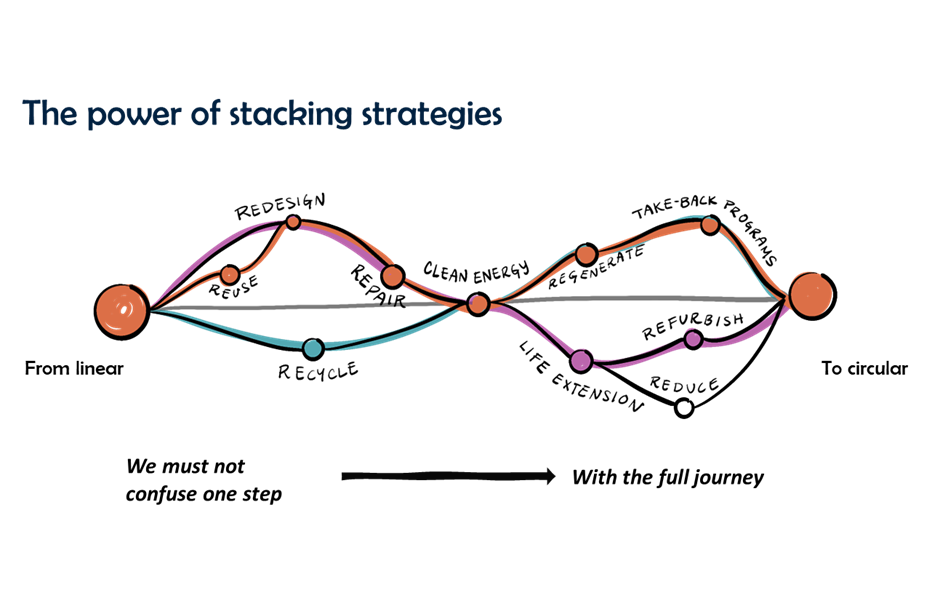
The stacking of circularity strategies is the name of the game
I often explain this using a health metaphor. If your doctor tells you that your health is poor, you are overweight and your sleep cycles are a mess, where would you start? Most of us are aware that there is no single fix. Drinking more water helps, as does walking more, sleeping better, eating differently, and reducing stress. Each change matters, but health comes from combining them into a coherent lifestyle. Circularity works in much the same way.
For me, the broader message is this: we should stop searching for the circular solution or technology and start designing with a stacking principle in mind. Recycling is not circularity. Redesign is not circularity. Lifetime extension is not circularity. Circularity emerges when systems are deliberately designed to let multiple strategies reinforce each other.
Circularity, in the end, is not a single move. It is something you build, layer by layer, through the careful threading of strategies across a system.